Post-Surgery Update: Two Weeks Out
We met with Ben’s surgical team yesterday to have his stitches removed — and the good news is he’s healing really well. The team said to expect about two more weeks of constant pain before it starts to fade to just occasional discomfort.
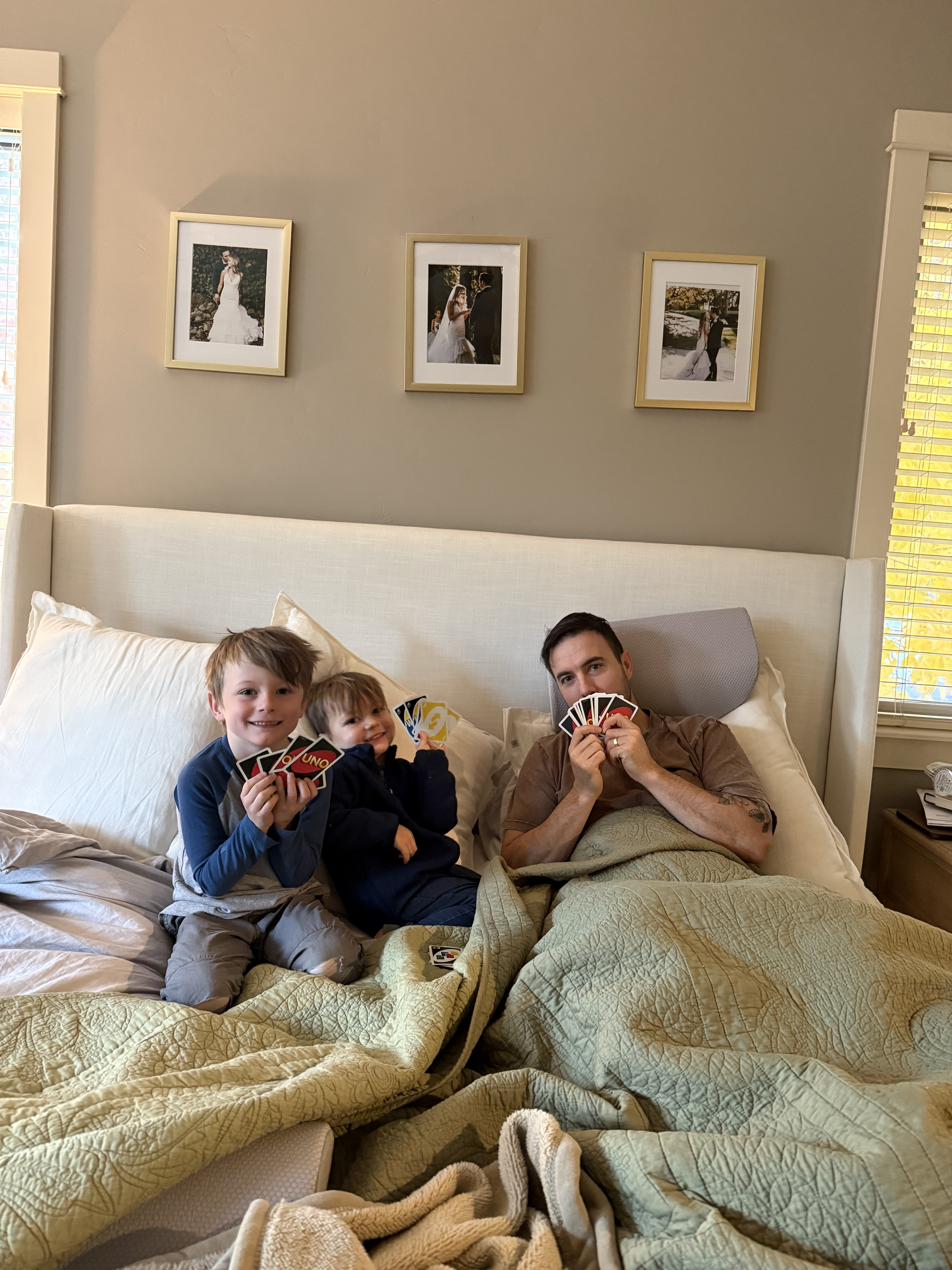
Ben is now completely off opiates and managing pain with Tylenol around the clock, ibuprofen a few times a day, and some CBD/CBG compounds for some added relief. He’s basically in the ‘grit it out’ phase of constant pain now. He’s walking about 1.5 miles a day (spread across three to four walks) and climbing two sets of stairs daily. His spirometer readings are already back up to 4000 — the max lung capacity — which is incredible progress this soon after surgery. He is joining family dinner at the table, playing Uno in bed with the kids before school, and slowly spending more time out of bed.
He still gets winded very easily and has what we’ve started calling a “double breathe,” a strange second inhale sound when he breathes in. The nerve pain is intense as everything reconnects, but his incisions look good. Most of the remaining discomfort is from where the ribs were separated during surgery.
What’s Next
Soon, Ben meets with a functional health practitioner to explore ways to support his recovery holistically.
He has appointments with:
Functional Oncologist in Bend – First week of November
OHSU Oncology Team – First week of November
Local Oncologist in Bend – First week of November
The functional oncologist will work alongside his primary oncology team, offering complementary therapies like IV supplements, hyperbaric oxygen therapy, mistletoe infusions, supervised fasting, and more.
We’re still waiting to hear back from UCSF Oncology to establish care. We’ll also be seeking second opinions from one or two rare tumor institutions — most of which operate as “pay-to-review” models. Because no one in the U.S. has published on Ben’s specific cancer type (H-FLAC), Sharee is also exploring potential international experts for insight.
Full pathology and molecular testing are still underway, being processed through UW/Fred Hutch. Molecular testing was ordered as well and is under way. Molecular testing will give us many of the answers we’re waiting for.
About Functional Oncology
A functional health or functional oncology practitioner looks at the whole body to search for root causes — things like inflammation, toxins, hormone imbalances, or immune dysfunction. They use both conventional and alternative therapies to support healing.
In contrast, a traditional oncologist focuses on treating the cancer directly — through surgery, chemotherapy, or radiation — and tends to look at individual systems rather than the body as a whole.
Together, these approaches can complement each other beautifully: traditional oncology works to eliminate the cancer, while functional care aims to strengthen the body, improve recovery, and help prevent recurrence.